Overview
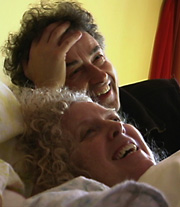
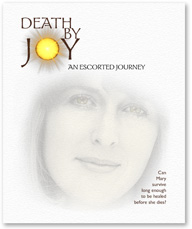
DEATH BY JOY is an escorted journey to the next world. Your guide is Mary, a quirky, selfless, funny, and irrepressible fifty-five-year-old who is told she will be dead in weeks without aggressive medical intervention.
But Mary chooses to forgo that route. The physical has a time and place; what matters more to Mary is that essence—call it awareness, spirit, soul, inner being—that she believes carries into the life beyond.
And so Mary embarks on a clear-headed quest for the true meaning of healing. Her joyful and startling discoveries can change profoundly your understanding of life, healing, and death.
This is a provocative look at a passionate journey; a tale of warmth, laughter, and music; a sharing in the fascinating visions of Mary’s travels across the “borderline.” It is an embracement of death, not steeped in sadness for what is to be lost but illuminated with the joy of what can be found.
Yet the path of epic journeys is seldom straight or free of struggle, a truth Mary experiences as she confronts the chilling reality of her shocking past.
Ultimately, DEATH BY JOY is a film about a great paradox: Can Mary survive long enough to be healed before she dies?
Director’s Statement
I suppose there are people whose interest in the subject of death would drive them to make a film about it. I am not one of them. Especially when the protagonist—the one who is dying—is a long-time, cherished friend. But Mary changed all that.
I was well along in preparing for a return to Africa to continue work on a documentary film there when Miranda called to say her mother was dying and would very much like to see Andrea (my wife) and me. So we flew to Canada’s easternmost Prairie Province, landing on a typical freezing winter day in Winnipeg, unaware that we were starting along a life-changing path the warmth of which has not diminished.
If you have ever visited the dying, you are probably familiar with a hushed, sombre setting. Yet as we arrived at Mary’s home to visit her, the front door only just opening, a wave of laughter pealed out above the music. Such was our introduction to Mary’s notion of how one should die.
Within a week I had postponed my travels to Africa, collected my filming equipment, and returned to Winnipeg, there to receive in person a whole-hearted welcome that had been extended over the phone to join the family and to document Mary’s passage to the life beyond. And what a passage it was. I spent nearly five weeks of long, lively days waking each morning—usually early so as to have some one-on-one time with Mary before the seemingly endless stream of friends would start to arrive—walking downstairs to Mary’s room on the ground floor, and immersing myself in an experience not quite, it seems in reflection, entirely of this world.
I learned quickly how little I knew about Mary even though we had been friends for many years; her exterior happiness concealed a childhood of such hurt I still cannot grasp it. Throughout her years she carried that burden. Yet she was determined to find the light penned by Hafiz, the Sufi poet:
“I wish I could show you,
When you are lonely or in darkness,
The Astonishing Light
Of your own Being!”
Mary’s journey was her effort to come fully into that light before she died. Is that not the journey of us all?
DEATH BY JOY is a film with no fluff; a documentary in the true sense of presenting a subject (in this case a difficult subject, for some even a taboo subject) as it unfolds, immersing you in the daily life of a woman, her family, and a community. There are the tender exchanges, the rough moments, the laughter, the music, the diaper changes, the visions—such extraordinary visions. And yet long after packing up the gear, after returning to the studio and logging the footage, after spending months of editing and finally completing the release, I found that all the scenes and snippets faded away to leave one simple impression: that of the unbridled joy Mary carried with her throughout her remarkable journey. A joy embodied in the words of Bahá’u’lláh, founder of the Bahá’í Faith:
I have made death a messenger of joy to thee. Wherefore dost thou grieve?
This is not an easy film to watch: as one viewer noted, it is “a powerful experience – haunting, difficult to watch at times, but ultimately rewarding and healing.” Nor is this a passive film: Mary sees to it that you will not feel like a spectator. If you are looking for a film of milk and honey, perhaps you should let this one pass. However, if you wish to engross yourself in a journey of discoveries, if you wish to break through the gauze of gloom and darkness that many cultures have wrapped around the most natural of human experiences, then do take in DEATH BY JOY. Rest assured you will come away from this film ultimately richer with a new outlook on dying. And living.
"There is no doubt that the film deals with difficult issues but its excellence lies precisely in its honesty. It moves because of its unsentimental treatment of its subject. It engages because of its humanity."
—Anton Floyd
Press Materials
20-Word Synopsis 
A candid story of one woman’s choice to find joy in dying and her unforgettable discoveries along the way.
50-Word Synopsis
DEATH BY JOY is a candid story of one woman’s choice to find joy in dying. Saying no to aggressive medical intervention, Mary embarks on a clear–headed quest for the true meaning of healing. Her unforgettable discoveries along the way can change profoundly your understanding of life, healing, and death.
100-Word Synopsis
DEATH BY JOY is a candid story of one woman’s choice to find joy in dying. Saying no to aggressive medical intervention, Mary embarks on a clear–headed quest for the true meaning of healing. Her unforgettable discoveries along the way can change profoundly your understanding of life, healing, and death.
The path of epic journeys, however, is seldom straight or free of struggle, a truth Mary experiences as she confronts the chilling reality of her shocking past.
Ultimately, DEATH BY JOY is about a great paradox: Can Mary survive long enough to be healed before she dies?
Director's Bio
Biography of director James Cribb